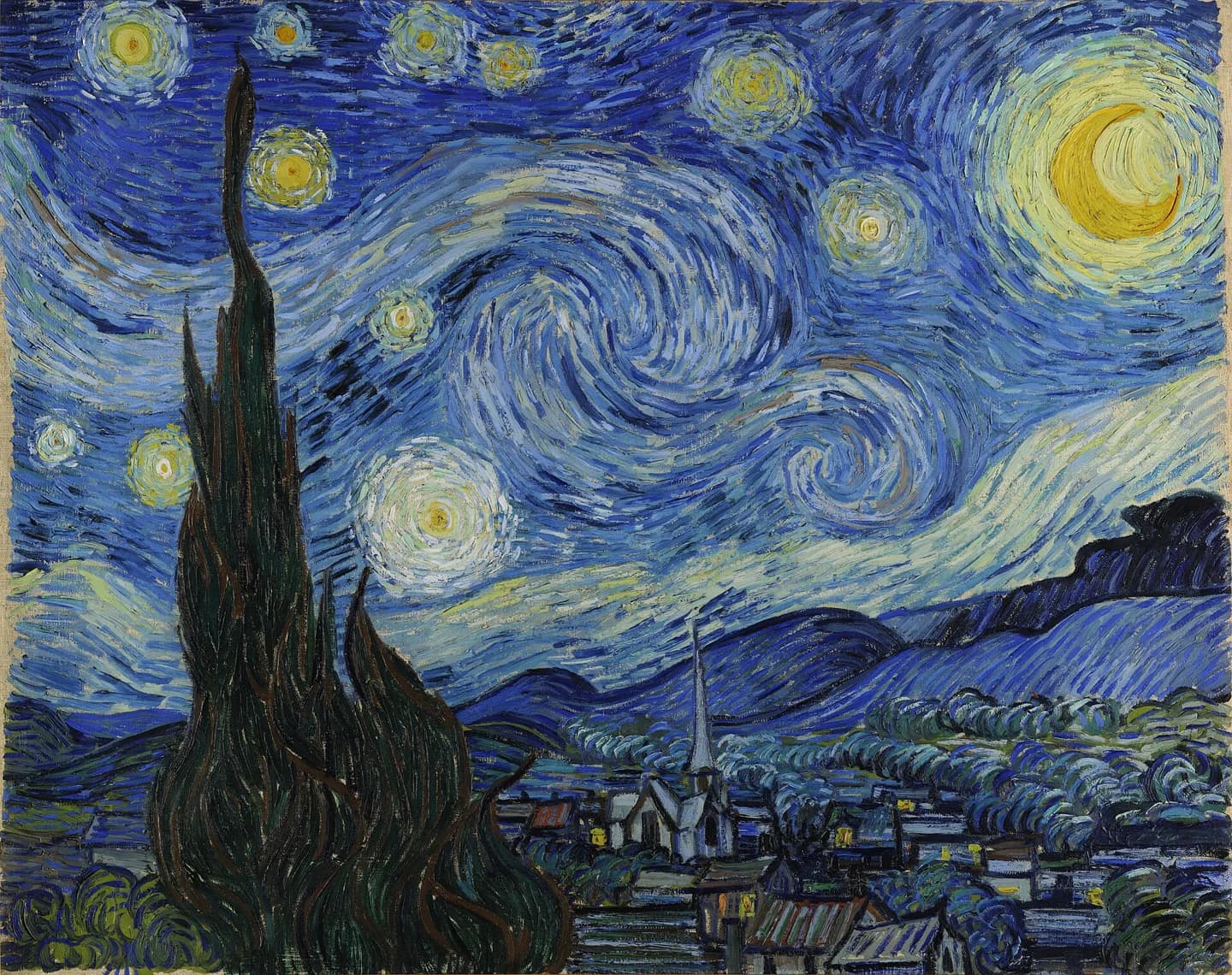
Bands of blue curl around bright stars above a small village. A dark cypress reaches from the foreground into the sky, linking two very different kinds of space. Notice the difference between the angular rooftops and the curved marks overhead.
The work in context
The Starry Night was painted in Saint-Rémy in June 1889 and is in the Museum of Modern Art’s collection. The scene brings a village, distant hills, a cypress and a luminous sky into one strongly organized image. It is a painting to examine as an arrangement of marks and shapes, rather than as a literal map of a particular night.
What to look for
Begin at the bottom, where roofs form a cluster of short diagonals. Move upward to the hills and then the long curves of the sky. The marks grow more sweeping as you rise. The cypress crosses this change in rhythm, while the bright stars pull the eye between separated points. The sky feels active partly because the village beneath it feels comparatively still.
Discover it in your focus time
This work is part of the Van Gogh collection in Tempo Canvas for iPhone. As you finish focus sessions, artworks become part of your personal gallery. Use your break to revisit a detail, then put your phone aside for the next task.
New to this kind of break? Try our guide to slow looking or set up your first Pomodoro session on iPhone.
Source & looking notes
Collection reference: The Museum of Modern Art — The Starry Night. Historical details and dates follow the linked collection record. The visual descriptions and observation prompts are original Tempo Canvas editorial interpretations.