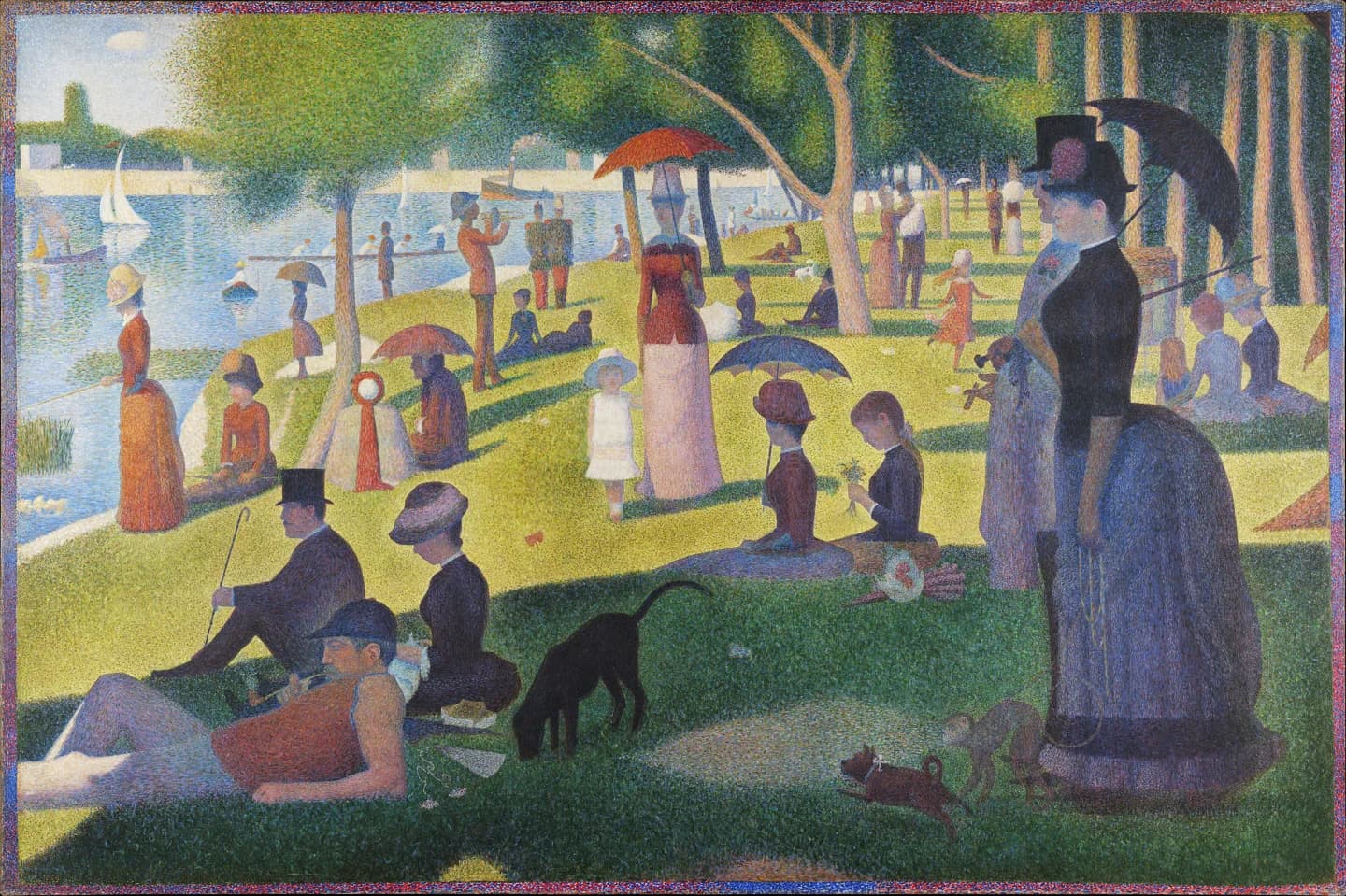
Figures, trees and parasols form a measured arrangement beside the water. From a distance the scene feels solid; closer looking reveals a surface built from many small touches. Compare the upright figures with the curving parasols and the bright strip of river.
The work in context
Seurat’s large riverside scene is in the Art Institute of Chicago, where it is titled A Sunday on La Grande Jatte — 1884 and dated 1884–86. Its surface is associated with the method often called pointillism: small touches of color contribute to the larger image. A reproduction lets you explore the arrangement, although it cannot reproduce the experience of the full-sized canvas.
What to look for
At first the figures can seem unusually still. Many are shown in profile or frontally, with clear boundaries between their shapes. Curved parasols balance upright bodies and trees. Move closer to the image and that firm structure breaks into colored marks. Moving between these two scales is part of what makes looking rewarding: the scene and the surface ask for different kinds of attention.
Discover it in your focus time
This work is part of the Impressionism & beyond collection in Tempo Canvas for iPhone. As you finish focus sessions, artworks become part of your personal gallery. Use your break to revisit a detail, then put your phone aside for the next task.
New to this kind of break? Try our guide to slow looking or set up your first Pomodoro session on iPhone.
Source & looking notes
Collection reference: Art Institute of Chicago — A Sunday Afternoon on the Island of La Grande Jatte. Historical details and dates follow the linked collection record. The visual descriptions and observation prompts are original Tempo Canvas editorial interpretations.